Blockchain in U.S. Payments: Architecture, Interoperability, and the Path to Production-Grade Deployment (Part 2)
Introduction
This is the second part in a two-part series on blockchain in payments. Part 1 covered instant use cases already delivering operational value. Part 2 focuses on the infrastructure choices that make those use cases possible. The goal is not to turn readers into protocol engineers, but to clarify the building blocks — network models, governance, layers, and key service-provider roles — so institutions can design a governed pilot, select partners, and integrate blockchain components into existing payment, treasury, and compliance operations.
Blockchain Fundamentals and Infrastructure
Blockchain is a distributed ledger — a shared database maintained and replicated across a network of nodes. For payments, the relevant properties are shared transaction state, tamper-evident records, and programmability. Shared state lets multiple parties rely on the same view of a transaction’s status without reconciling separate ledgers after the fact. Tamper-evident records create audit trails that are often easier to verify than fragmented logs.
For its users, this can translate into:
- Smart contracts that automate defined business rules, policy checks, compliance rules, and controls such as eligibility, limits, conditional release, and reporting triggers.
- Tokenization of deposits or payment instruments to support faster settlement and continuous operating hours.
- Cryptography that secures data integrity and creates tamper-evident audit trails.
- Resilience, which is achieved through redundancy since records are replicated across nodes rather than stored in a single database.
Public vs. Permissioned Ecosystems
A central adoption decision is whether a use case belongs on a public permissionless network , a public permissioned network, or a private permissioned network. All can support shared ledgers and smart contracts, but they differ in participation, governance, privacy, and accountability.
Public permissionless networks are open, anyone can run nodes and deploy contracts. Governance is decentralized through open-source processes, validator participation, and community consensus. Regulated institutions typically meet compliance obligations through smart contracts within the blockchain as well as controls at the edges through issuers, custodians, exchanges, wallet providers, and policy engines.
Public permissioned networks use publicly accessible infrastructure which restrict certain roles or activities — such as stablecoin issuance, validator participation, or privileged smart contract execution — to approved, permissioned entities. This preserves transparency, interoperability, and shared settlement benefits of public blockchains while introducing formal governance, compliance controls, and accountability — useful when responsibility for reserves, redemption, and compliance enforcement must be clearly assigned.
Private permissioned networks restrict participation to vetted parties and use contractual governance. They can enforce privacy and operational controls more directly, with defined upgrade processes, dispute procedures, and clear responsibilities for node operation and data access.
In practice, the choice is less about ideology and more about risk tolerance, privacy requirements, and how the workflow must integrate with existing rails and reporting systems. All three approaches bring value, but their strengths differ in important ways. Public permissionless networks excel at enabling open application development, composability, and access to broad liquidity across a shared global settlement layer. Public permissioned networks balance these benefits with regulatory clarity and institutional accountability. Private permissioned networks, by contrast, are optimized for regulatory alignment, operational control, and clearly defined governance, participation, and data access.
Key Considerations
As institutions move from experimentation to production, the following four issues require attention:
- Governance: Protocols defining who can change rules, validate transactions, approve upgrades, resolve disputes, and exercise authority during incidents, whether through DAOs, consortium governance, or oversight bodies such as Nacha.
- Interoperability: Ensuring new systems connect to existing rails, treasury/ERP systems, compliance tooling, and other blockchain platforms without creating new silos.
- Performance: Meeting throughput, latency, resilience, and incident response requirements for the specific transaction workflow.
- Security and Fraud: Ensuring strong identity verification, wallet controls, transaction monitoring, and fraud detection as transactions move to faster, automated settlement environments.
Understanding the Layers : Blockchain payment systems are increasingly built as layered stacks, with different providers specializing at different points [1] (e.g., settlement layers, orchestration, and interface).
Layer 0 – The Connective Tissue: This is the infrastructure layer that bridges/connects blockchains — comparable to the power grid or rail system operating behind the scenes. It enables interoperability, shared security, and permissioned environments tailored for compliance, and is where most bridges and interoperability frameworks are built. Governance at this layer typically involves protocol-level decisions related to connectivity, coordination, and upgrades.
Layer 1 – The Base Network: This is where decentralized infrastructure processes transactions and maintains the authoritative ledger. It provides access to established tooling and developer ecosystems, with governance most visible at this layer through decisions on consensus rules, validators, and protocol upgrades. While APIs for application developers exist here, each transaction must be validated and agreed upon across a distributed network of validator nodes, which constrains throughput and latency. As a result, this layer often requires additional support to meet the scalability and performance needs of high-throughput or regulated payment use cases.
Layer 2 – The Scaling Layer: Built on top of Layer 1, these protocols reduce cost and latency and improve the user experience. For payments, Layer 2s frequently provide the tooling (APIs/SDKs) and performance characteristics needed for merchant settlement, peer-to-peer transfers, programmable liquidity, and payroll-like flows.
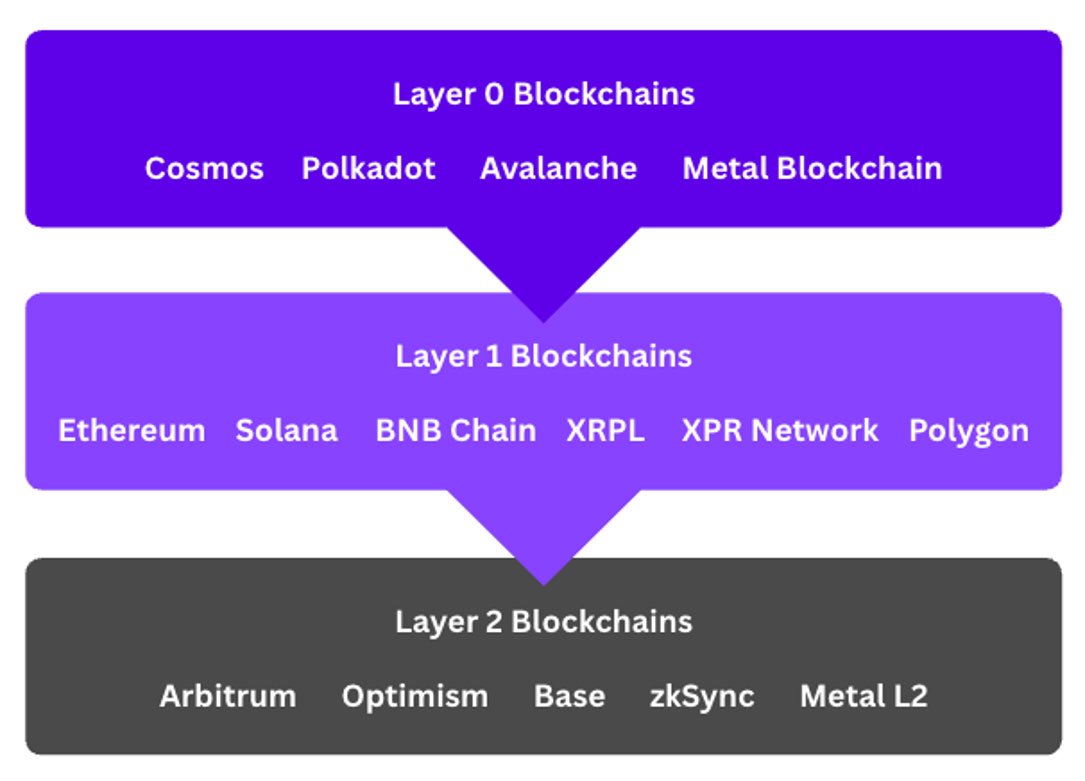
For adopters, the key is understanding where settlement finality occurs, where controls are enforced, and which layer a vendor is providing services.
The Blockchain Payment Stack and Key Provider Roles
Production implementations typically involve three kinds of participants.Non–Crypto-Native Financial Networks: Global payment giants like JPMorgan Chase, Citigroup, Visa, Mastercard, PayPal, MoneyGram, and Western Union have long moved funds through global correspondent, merchant, and remittance networks. Their advantage is in pre-existing institutional relationships, regulatory integration, and established corridors. By integrating blockchain-based settlement components, incumbents are extending operating hours and reducing settlement times and reconciliation without rebuilding access and liquidity arrangements from scratch. Some are also exploring or launching stablecoins, tokenized deposits, and deposit tokens as new settlement instruments within their existing payment networks.
Crypto-Native Issuers and Payment Rails: Crypto -native firms such as Circle and Paxos focus on issuing regulated digital money, while networks like Ripple/XRPL, Stellar, and Base provide the rails on which those assets move. These peer-to-peer networks support direct settlement on shared ledgers, which today are typically accessed through regulated intermediaries and partnerships. This model may evolve as regulators move toward granting select crypto-native issuers of regulated digital money bank-like privileges, reducing reliance on intermediaries and reshaping how exchanges and other market participants access payment infrastructure.
On-Chain FX, Liquidity, and Orchestration Providers: A third group of integrators focuses on liquidity sourcing, FX conversion, routing, policy controls, and wallet infrastructure. For example, Stellar’s anchor ecosystem and Adhara operate within the payment rail, where settlement finality, liquidity, FX, and compliance are executed as part of the transaction. By contrast, Fireblocks and Ripple ODL operate above the rails, coordinating custody, liquidity, and routing across multiple networks and counterparties.
Understanding Layered Partnerships
Deployments of blockchain-enabled payments increasingly rely on layered partnerships that combine institutional networks, peer-to-peer settlement rails, issuing, and liquidity and orchestration providers. No single firm delivers the full stack; instead, value emerges from how these roles are assembled and governed. Many of these ecosystem participants are pursuing partnerships or mergers and acquisitions as the market simultaneously expands and consolidates.
This pattern is already visible across the market. Visa has supported USDC settlement over public blockchains, while SWIFT is piloting a shared blockchain-based ledger with partners including Consensys and major financial institutions. [2] [3] Meanwhile, MoneyGram has launched stablecoin-powered cross-border payment experiences leveraging Stellar, Circle’s USDC, and wallet infrastructure from Crossmint, while expanding partnerships with Fireblocks to embed blockchain settlement and on-/off-ramp capabilities directly into its global network. [4] [5]
Financial institutions are following a similar path. The issuance of a deposit token on Base (Kinexys by J.P. Morgan) illustrates how incumbents can leverage public permissioned blockchain infrastructure to extend reach and functionality while remaining anchored in regulated financial systems. [6] Together, these examples reflect a broader trend: traditional financial institutions are collaborating with fintech and blockchain firms to integrate decentralized payment rails into existing payment, treasury, and compliance frameworks rather than replacing them outright.
For institutions evaluating blockchain-enabled payments, the key is understanding how these players fit together across the stack — who issues the on-chain instrument, where settlement finality occurs, who provides liquidity and FX, and where compliance and operational accountability ultimately reside. Mapping these roles clearly is essential to designing governed pilots that can scale into production.
Compliance, Fraud, and Identity Foundations
For institutions evaluating blockchain adoption, there are further architectural decisions that need to be made around compliance, fraud prevention, and identity. These need to be part of any blockchain adoption strategy as they shape network selection, governance models, data access controls, and integration requirements across the stack. Designing them upfront is essential.
Blockchain enables “compliance by design” — embedding controls such as whitelisting, transaction limits, geographic restrictions, sanctions screening, and reporting triggers directly into transaction flows. In permissioned or regulated issuance models, these controls can be enforced at the protocol or application layer by using smart contracts rather than retrofitted through post-transaction monitoring.
In practice, most implementations rely on a layered compliance architecture. On-chain transparency is complemented by analytics and RegTech (regulatory technology) providers such as TRM Labs, Chainalysis, Elliptic, and CipherTrace, which monitor activity across networks,(including bridged blockchains and all blocks of a given blockchain) identify illicit typologies, flag sanctioned actors, score wallet risk, and support investigations in near real-time. [7] At the operational edge, institutional wallet platforms such as Fireblocks embed policy engines, transaction screening, geo-fencing, segregation of duties, and Travel Rule tooling where users initiate transactions. [8] Together, these layers determine how compliance responsibilities are distributed across the stack.
- Where are compliance rules enforced—on-chain, off-chain, or both?
- Which activities require real-time controls versus post-transaction review?
- How are identity, permissions, and audit access managed across counterparties?
- Which vendors provide analytics, wallet controls, and reporting? How do they integrate with existing systems?
Conclusion
In developing a blockchain strategy, institutions need not pursue wholesale transformation. They need enough technical clarity to choose the right operating model for a governed pilot with measurable outcomes. Start with one workflow, choose the network model, define governance and controls, assign ownership for compliance and incident response, then integrate with systems of record. Teams that build this literacy now will be better positioned to scale blockchain-enabled payments responsibly as standards, tooling, and partnerships mature.
[1] https://metalblockchain.org/news-insights/metal-blockchain-deep-dive-series
[2] https://usa.visa.com/about-visa/newsroom/press-releases.releaseId.21951.html?utm
[3] https://www.swift.com/news-events/press-releases/swift-add-blockchain-based-ledger-its-infrastructure-stack-groundbreaking-move-accelerate-and-scale-benefits-digital-finance?utm
[4] https://thepaypers.com/crypto-web3-and-cbdc/news/moneygram-and-fireblocks-partner-to-support-stablecoin-use?utm
Digital Assets in the Financial Industry Work Group
Thank you to the members of the FPC Digital Assets Work Group (DAWG) who contributed to this blog.
Digital Assets Work Group Leadership
| Avenue B Consulting, Inc. | Bo Berg, Work Group Chair |
| SRM | Larry Pruss, Work Group Vice Chair |
| Avenue B Consulting, Inc. | Maria Arminio, Work Group Facilitator |
Digital Assets Work Group Members
| 7T World LLC | Anthony Serio, Editorial Review |
| AFM Consulting LLC | Aaron McPherson |
| Alacriti | Divya Raghupatruni |
| American Express | Margaret Rae |
| BNY | Eric Peterson |
| Banker’s Bank of Kansas | Daniel Hayden |
| BVNK | Keith Vander Leest |
| Candescent | Marcia Klingensmith |
| Fincom | James Hutchison |
| Form3 US Inc. | Gursharan Singh |
| FPC Member | Jonathan Holland |
| Matera | Sarah Hoisington |
| Matera | John Wilson |
| Metallicus | Frank Mazza |
| Nacha | Mark Dixon |
| National Consumer Law Center | Carla Sanchez-Adams |
| PayGility Advisors LLC | Deborah Baxley |
| PayGility Advisors LLC | David True |
| Payments as a Lifeline | Mark Steven |
| Payments as a Lifeline | Kirsten Trusko |
| Phatdog Enterprises LLC | Dean Nolan |
| Pidgin | Kevin Olsen |
| PTap Advisory, LLC | Peter Tapling |
| The Bancorp Bank, N.A. | Bill Rambadt |
| US Bank | Sara Cichoski |
| Vments, Inc. | Steve Wasserman |
About the Digital Assets in the Financial Industry Work Group
Maps out how digital assets relate to the financial industry, focusing specifically on payments made with digital funds – central bank digital currency (CBDC), regulated liabilities, and stablecoin.
About the U.S. Faster Payments Council
The U.S. Faster Payments Council (FPC) is an industry-led membership organization whose vision is a world-class payment system where Americans can safely and securely pay anyone, anywhere, at any time and with near-immediate funds availability. By design, the FPC encourages a diverse range of perspectives and is open to all stakeholders in the U.S. payment system. Guided by principles of fairness, inclusiveness, flexibility, and transparency, the FPC uses collaborative, problem-solving approaches to resolve the issues that are inhibiting broad faster payments adoption in this country.